
Lexington County City Directory Collections
Lexington County Library’s South Carolina Room is the verified starting point for historical directory work. It collects material on Lexington County, the former Orangeburgh District, and South Carolina, and its genealogy resources point researchers to directories, census material, local newspapers, FamilySearch resources, and Ancestry Library Edition. The library has not published a shelf-by-shelf city directory list online. Ask staff or consult the catalog for the exact title, publisher, and year before treating a volume as a Lexington County city directory.
| Collection | Confirmed years or scope | Where held | Access |
|---|---|---|---|
| South Carolina Room local-history collection | Specific city-directory years are not published online | Lexington Main Library, ground floor | Catalog and staff-assisted research |
| The Batesburg Advocate | 1901–1911 | Listed by the county library genealogy resource | Newspaper research lead |
| The Lexington Dispatch | 1873–1916 | Listed by the county library genealogy resource | Newspaper research lead |
| Lexington Dispatch-News | 1917–1919 | Listed by the county library genealogy resource | Newspaper research lead |
| The Dispatch-News | 1919–1922 | Listed by the county library genealogy resource | Newspaper research lead |
| Columbia city directories digital collection | Selected volumes from 1859 through 1927 | University of South Carolina digital collections | Free full-text collection, Columbia/Richland context only |
Use the physical collection, licensed databases, microfilm, or staff help when a title is not online. A reverse or criss-cross volume may be useful if the library catalogs one for the needed period, but no publicly digitized Lexington County reverse-directory run with stated years was verified.
Note: Record a catalog citation or title-page image before relying on any local directory year or publisher name.
Lexington County City Directory Starting Point
The South Carolina Room is at Lexington Main Library, 5440 Augusta Road, Lexington, SC 29072. Its published collection includes noncirculating reference books and maps, local obituary indexes, microfilmed newspapers, census, historical papers, family histories, military records, and photographs. The room lists Monday through Thursday hours of 8:30 a.m. to 8 p.m., Friday and Saturday hours of 8:30 a.m. to 5:30 p.m., and Sunday hours of 2 to 5 p.m. Call or email the library before a focused city directory visit, especially when a licensed database or staff-assisted reproduction may be involved.
View the Lexington County Library South Carolina Room source before visiting.
The collection route is stronger than an assumed run of books: it gives a researcher a real counter, catalog, staff contact, and several types of dated family evidence.
Lexington County City Directory Gaps
When a city directory year cannot be verified, the named local newspaper runs create a dateable bridge. The library identifies The Batesburg Advocate for 1901–1911, The Lexington Dispatch for 1873–1916, Lexington Dispatch-News for 1917–1919, and The Dispatch-News for 1919–1922. Engagement notices, obituaries, legal notices, school items, business notices, and reports of moves can help place a household between census years. A missing notice does not establish that a person was absent from Lexington County.
See the library’s genealogy and local-newspaper resource list for the confirmed titles and research tools.
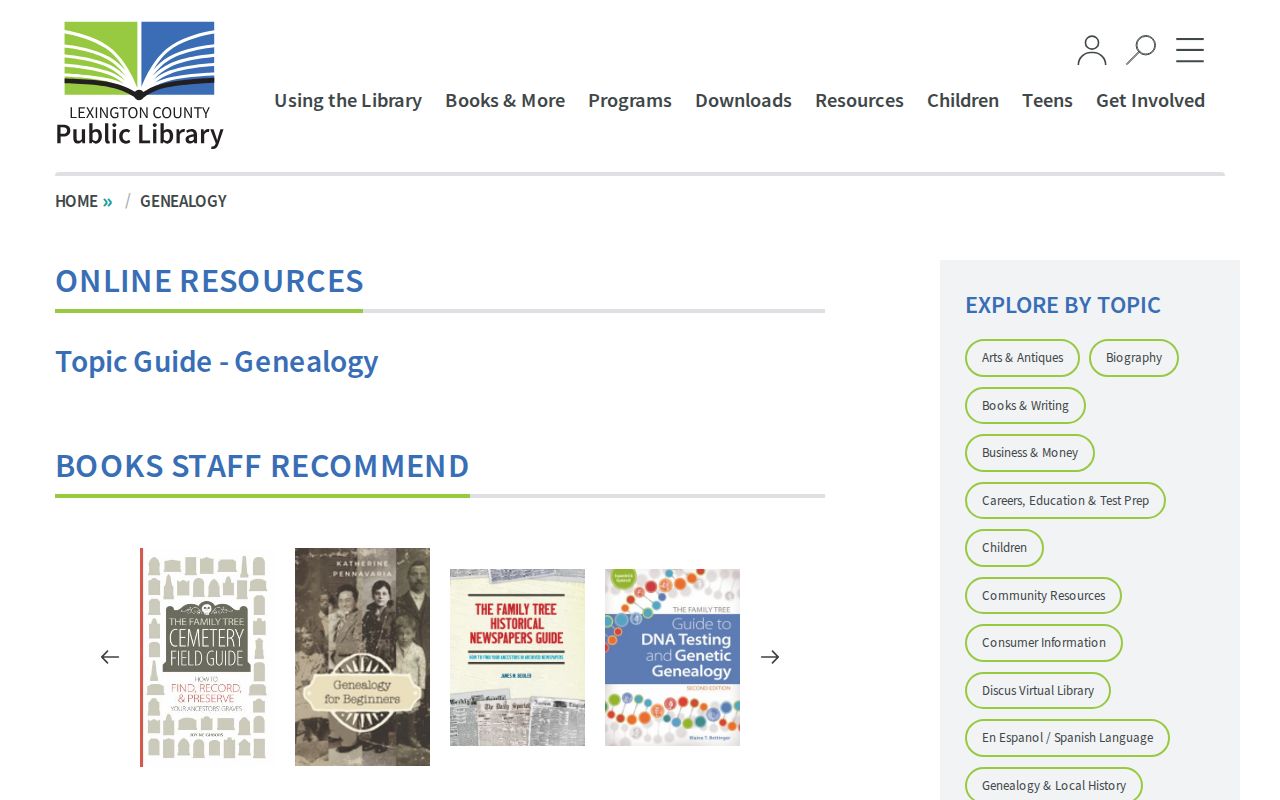
Newspapers are best used beside a directory entry, deed, probate item, or released census schedule, where a date and locality can be checked against an independent record.
The library’s obituary index offers another later-stage check. Its stated Lexington Dispatch-News coverage is 1873–2001, except February 24, 1944 through October 4, 1962, a gap that should remain visible in any family timeline.
Lexington County City Directory Context
The University of South Carolina’s Columbia city directories digital collection is searchable and can help with a documented Columbia, Richland, Brookland, or Columbia-area connection. It is not a verified countywide Lexington County directory run. Treat it as contextual material only, and do not use a Columbia listing to establish residence elsewhere in present-day Lexington County. Its confirmed holdings include volumes dated 1859, 1860, 1868, 1875–76, 1879–80, 1888, 1891, 1895, 1897–98, 1899, 1901, 1903, 1904–05, 1905, 1906, 1907–08, 1909–1917, 1922, and 1927.
Open the digitized 1911 Walsh directory specimen to see the collection’s navigation and historical organization.
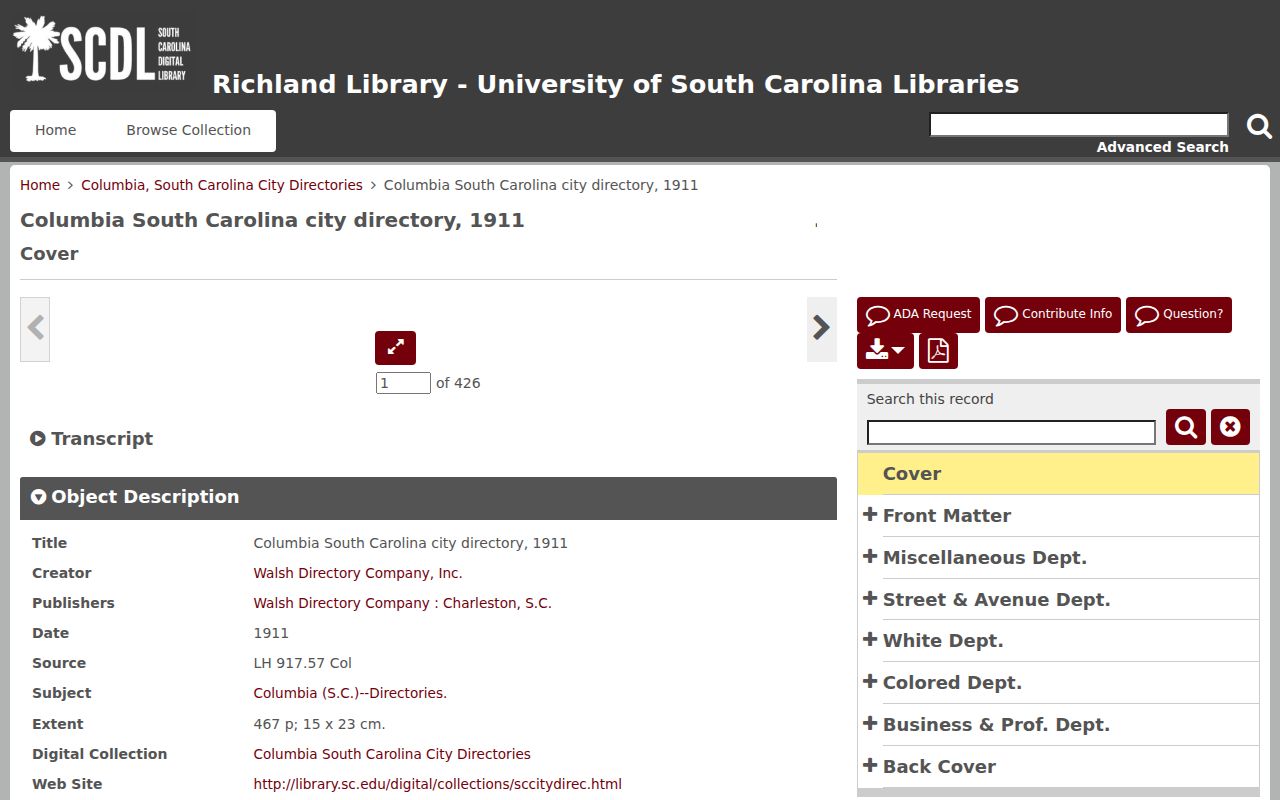
The 1911 volume has 467 pages and separate street, white, Black, and business/professional divisions. That racial organization is a feature of the historic source, not a modern classification to repeat without context.
Reading a Lexington County City Directory Entry
Inspect the selected volume before expanding abbreviations. Preserve the title page, place, edition year, publisher or compiler, repository, and page number. Then copy the entry as printed: surname, given name or initials, spouse or widow notation, home and business addresses, occupation or employer, cross-references, and any owner or renter notation. The 1905 Columbia collection page demonstrates a common historic field pattern, including a residence marked “r,” but each volume’s own key controls the meaning of its marks.
| Publication identity | Exact title, place, edition, publisher, date, repository, and page. |
|---|---|
| Listing identity | Spelling, initials, spouse or widow indicator, and cross-reference. |
| Location | Home and business addresses separately, plus street-range context if printed. |
| Activity | Occupation, employer, business, office, telephone, or group only when the volume prints it. |
| Editorial clues | Abbreviation key, alphabetical or street section, advertisement status, and page number. |
- Criss-cross directory
- A directory arranged by street and number rather than surname. Its availability and years must be confirmed from the relevant collection.
- Householder index
- An index centered on the named household contact, not necessarily every person at the address.
- Abbreviation key
- The volume’s own explanation of marks and shortened words. Photograph or transcribe it before interpreting an entry.
Lexington County City Directory Surroundings
The Lexington County Museum supplies built-environment and community context for a city directory trail. Founded in 1970, it describes a seven-acre downtown campus with more than 30 historic structures moved from across the county, a late-nineteenth-century post office, and the John Fox House, built in 1832. That history explains why an old address can have a complicated story. A building may have moved, been renumbered, or been placed under a different municipal or postal description.
Review the museum’s local-history collection source when the question concerns a place as well as a name.
For primary county records or historic record books, use the South Carolina Department of Archives and History as the archival bridge. Give the archivist a locality, surname variants, record type, date range, and known book, page, parcel, or census clues.
Note: Museum material gives useful local context, but a deed, plat, court file, or other custodian record remains the formal source for its own subject.
Lexington County City Directory Timelines
Local History Digital Collections adds a remote discovery route for the historical shelf. The library launched the searchable platform in February 2025 for local photographs, audio, and rare printed items, though some items have login or approved-IP limits. Its collections inventory is arranged around Batesburg-Leesville, Bookmobile, Cayce-West Columbia, Chapin, Gaston, Gilbert-Summit, Irmo, Lexington Main, Pelion, South Congaree-Pine Ridge, and Swansea. Use an item record to identify a place or date, then ask the South Carolina Room whether a related directory, clipping file, or printed source is available.
- 1873: the library’s named Lexington Dispatch newspaper run begins.
- 1917–1922: the library identifies the Lexington Dispatch-News and Dispatch-News title transition.
- February 2025: the library launched Local History Digital Collections for searchable local material.
The timeline marks documented resources, not a claimed publication timeline for a Lexington County city directory. Exact directory years and publishers remain a catalog-and-staff question.
Tracing Lexington County City Directory Families
A Lexington County city directory entry is most useful as one point in a dated sequence. Begin with the latest confirmed listing and retain its literal name form, street, and any occupation note. Look at the preceding and following verified volumes for a first appearance, address change, or a notation that the volume itself defines. Then pair the chronology with the correct federal census schedule, released through 1950 under the 72-year rule, and with local newspapers, deed records, probate material, cemeteries, or the obituary index as the question requires.
- Identify a confirmed directory or phone listing and preserve its title, page, and exact wording.
- Check adjacent verified years for changes in spelling, address, occupation, or household notation.
- Compare the address to the appropriate released census locality and enumeration district, not merely a modern county label.
- Use newspaper notices or the obituary index to test a move, death, estate event, or family connection.
- For property continuity, compare the street clue with a parcel, legal description, and recorded deed rather than relying on a directory alone.
A disappearance can reflect a move, death, omission, changed spelling, or a different listing practice. It is a prompt for another record, not a final conclusion. Modern parcel and ownership research belongs on the Lexington County by-street directory route, where address-keyed county records are handled directly.
Lexington County City Directory Access
Not every useful directory companion is available from home. The library identifies Ancestry Library Edition as an in-library resource with directories, census records, vital-record references, and photographs. It also points researchers to FamilySearch resources and its newspaper directory. Ask staff about access terms before travel, then preserve the exact title, publisher, year, page, and database or shelf source used. A database search result is only a lead until the selected image or original volume is checked.
The LCPL Obituary Index offers a separate, named historical route. It accepts a required whole or partial last name, an optional first or nickname field, and an optional death-year selection. Its result identifies an obituary or newspaper lead, not a full residence history. Library patron registration and circulation records remain confidential under South Carolina FOIA, so a public historical collection cannot reveal who borrowed or consulted an item.